
Our Approach
The Strategy in Action System (SiA): strategy that keeps pace with change
A proven strategy system for organisations facing disruptive change, uncertainty and constant pressure to adapt.
The problem
Most strategy is built for a world that no longer exists

Traditional planning assumes the future will look enough like the past to plan for. It won’t. By the time a three-year plan is approved, the conditions it was built on have already shifted.
The result is a growing gap between what organisations say they’ll do and what the world now demands. The Strategy in Action System (SiA) was built to close that gap.
What is It?
What is The Strategy in Action System?
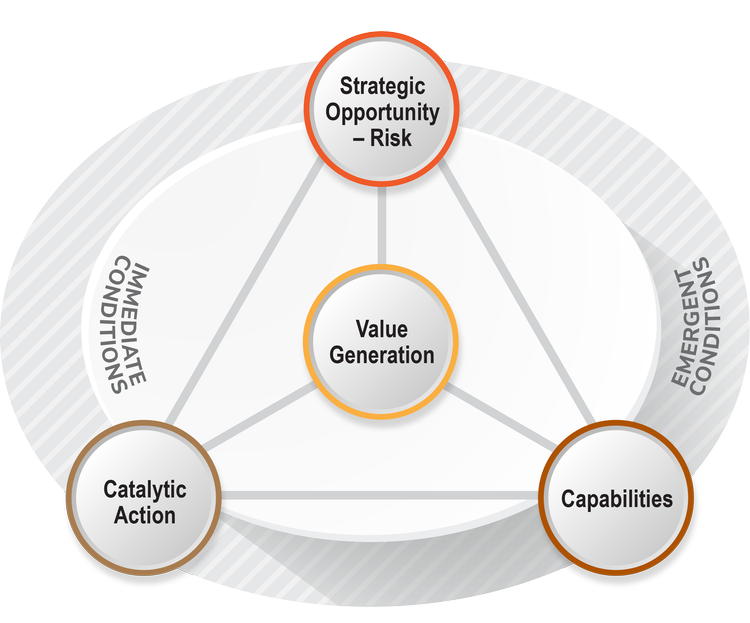
SiA is Resilient Futures’ strategy framework and toolset. It shortens the cycle between strategic thinking and action, so strategy becomes part of how your organisation runs every day.
Conceptualised by Co-Founder Larry Quick in the 1990’s, SiA has been refined over more than 25 years of work with government, industry, community organisations and associations. It is designed for complex, fast-moving and exponential change.
The principal at the heart of SiA
To generate value, your capabilities and actions must constantly align with the conditions and the opportunity-risk in front of you. When they drift apart, value is lost.
Every tool in SiA exists to keep that alignment, and to show you early when it’s slipping.
The five elements
Five elements of strategy that works
The five elements are also five standards. Most strategies fall short on at least one, which is why SiA is as useful for testing a strategy as for building one.
-
Conditions
Understand the landscape of change through rigorous, regular conditions analysis across global, national, industry and internal forces.
The standardIs your strategy built on the world as it is now?
-
Sustainable value
Focus on value that endures. Map how value flows between you and the people, partners and environment you depend on.
The standardWill the value you create still matter as conditions change?
-
Strategic opportunity-risk
Opportunity and risk usually come from the same source. See them together, then prioritise what will move you forward.
The standardAre you focused on the changes that matter most?
-
Capability
Build or acquire the capability you need to stay ahead of your sector, not just keep up with it.
The standardDo you have what it takes to deliver your priorities?
-
Catalytic action
Take targeted, low-cost actions that build momentum fast. Test, learn and grow in short cycles.
The standardIs your strategy moving, or just agreed?
How it works
How The Strategy in Action System works
-
Step 1
Read the conditions
Build a shared, evidence-based view of the forces shaping your organisation.
-
Step 2
Find the opportunity-risk
Identify and prioritise where conditions open doors and where they close them.
-
Step 3
Define sustainable value
Clarify the value you will create and capture, now and into the future.
-
Step 4
Build capability
Pinpoint what you need to build or acquire to pursue your priorities.
-
Step 5
Take catalytic action
Launch fast, focused actions that test, learn and build momentum.
-
Step 6
Check and adapt
Monitor alignment continuously, and rethink as conditions move.
The last step leads back to the first. That loop is what makes strategy continuous.

Ways to work with SiA
We do it with you, or we teach you to do it
We do it with you
Facilitated strategy
Our team guides your leaders through the Strategy in Action System to develop, refresh or stress-test your strategy.
Explore strategy developmentWe teach you to do it
Capability building
We train your people to use the tools of the Strategy in Action System themselves, so strategy keeps moving long after we’ve left.
Explore capability buildingEither way, everything is co-designed with you. We start small, grow strong, and build from what works.
What changes
What organisations gain

A shared view of reality that makes decisions faster and less contested.
Clear priorities grounded in the conditions you actually face.
Earlier warning when assumptions stop holding.
Leaders who can adapt strategy without starting again.
Momentum from action, not just agreement on a plan.
“It is a simple and intuitive model. My sense is that the Resilient Futures team genuinely wants to help people and organisations confront exponential change; the SiA framework is certainly a useful tool to achieve this goal.”
Sam Bonwick, Optometry Australia